How Often Should Senior Dogs Go to the Vet and What Changes After Age 7?
TL;DR: Most veterinarians recommend twice-yearly wellness exams for dogs over age 7. Senior dogs experience health changes more rapidly than younger animals, and the conditions most common in older dogs (kidney disease, arthritis, dental disease, and cardiac changes) progress faster than a once-yearly exam cycle can reliably catch.
If your dog has crossed the seven-year mark, you have probably noticed small things. The stairs take a second longer. The gray is spreading around the muzzle. Maybe breakfast disappears a little less eagerly than it used to. These changes feel gradual, but inside an aging dog's body, the pace of physiological change picks up considerably. For Plantation families with senior dogs, understanding how veterinary visit frequency should shift with age is one of the most straightforward ways to protect the years you have left together.
How Often Should Senior Dogs See a Veterinarian?
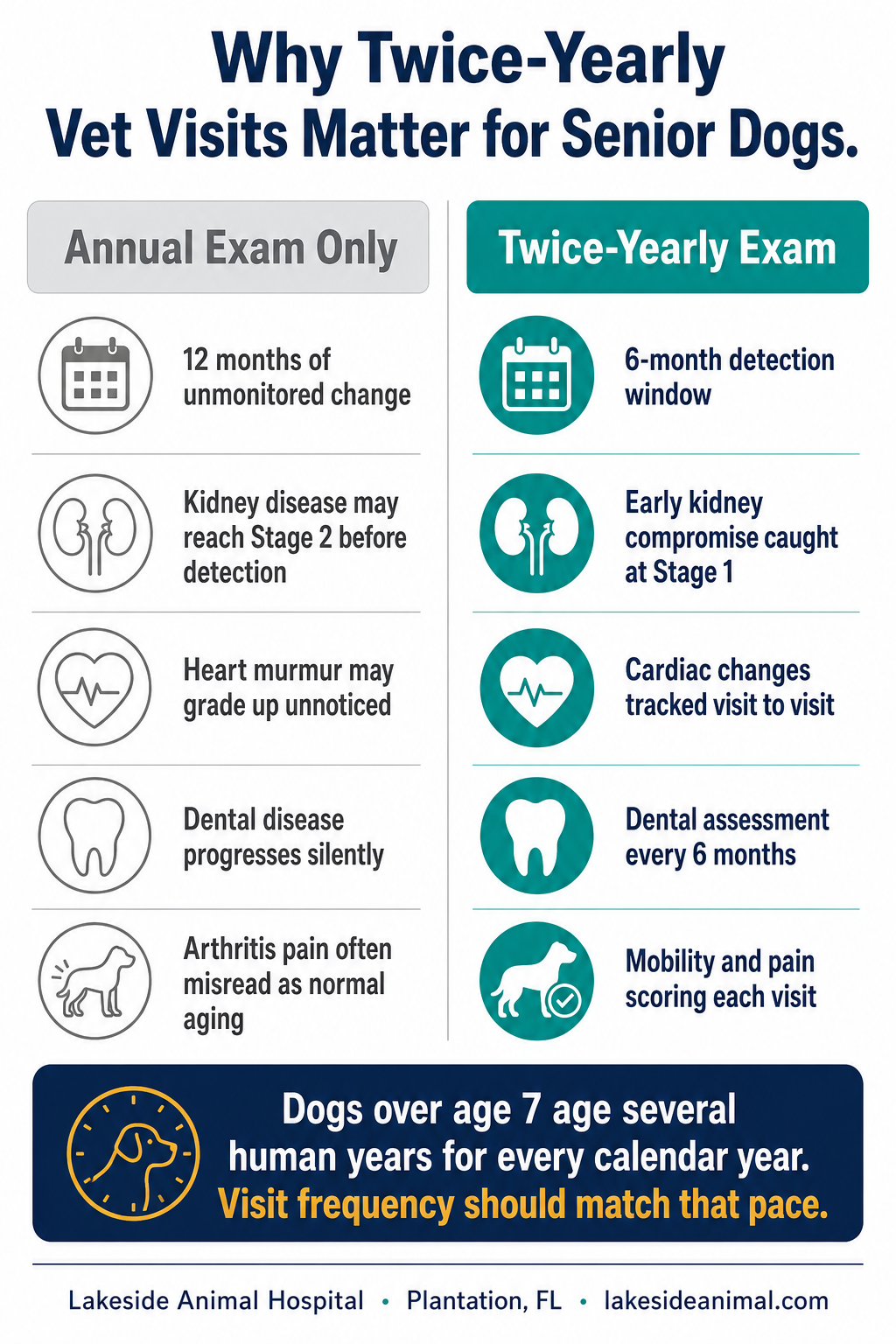
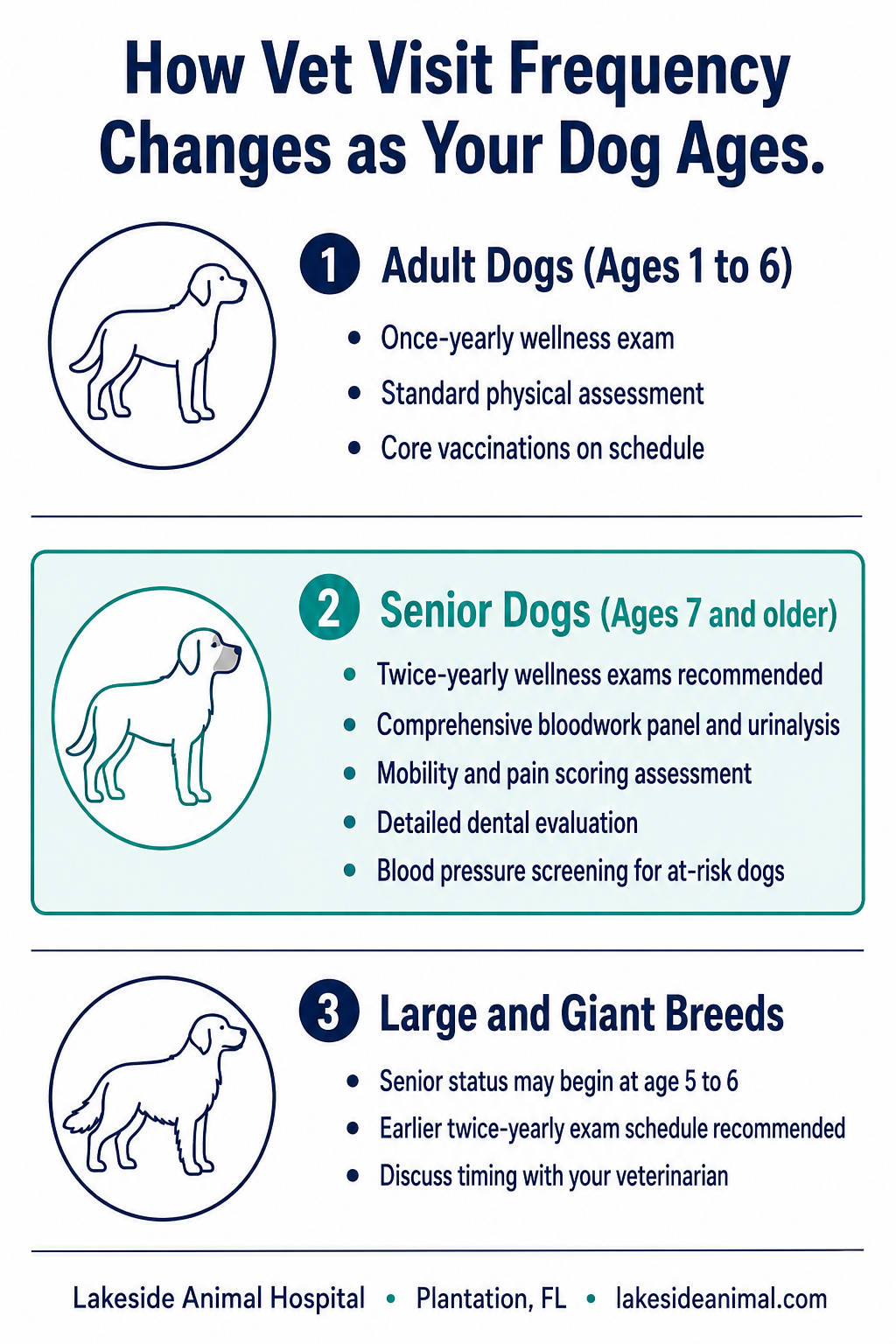
Dogs over age 7 should see a veterinarian twice per year. One calendar year in a senior dog's life is equivalent to several human years, and conditions like kidney disease, heart disease, and arthritis can move from manageable to advanced within a single annual exam gap. Twice-yearly visits create a monitoring rhythm that matches a senior dog's actual rate of change.
This is not about being overly cautious. It is about math. A dog who comes in every twelve months gives the disease twelve months of unmonitored runway. A dog who comes in every six months gives early kidney compromise, a grading heart murmur, or a developing dental infection far less time to quietly worsen. The visit cadence is the intervention.
For large and giant breed dogs, some veterinarians recommend beginning twice-yearly exams as early as age 5 or 6, since larger dogs age faster than small breeds. Your dog's breed, size, and current health history will shape the exact schedule Dr. Frione recommends for your specific animal.
What Does a Twice-Yearly Senior Exam Catch That an Annual One Might Miss?
Between annual exams, kidney values can shift from normal to early compromise, dental disease can advance from gingivitis to significant periodontal disease, and a previously mild heart murmur can grade up. These are not rare edge cases. They are predictable progressions in aging dogs that a twice-yearly exam schedule is designed to intercept.
Kidney disease is a strong example. Dogs in early kidney disease often show no outward symptoms at all. A bloodwork panel that comes back borderline at the January visit, rechecked in July, tells a very different story than one that goes unchecked for a full year. Catching kidney compromise at stage one rather than stage two or three changes the entire treatment picture and the long-term prognosis.
Dental disease follows the same pattern. Significant periodontal disease causes chronic pain that most dogs never show clearly. It also creates a direct pathway for oral bacteria to affect the heart, kidneys, and liver. A dental assessment at every wellness visit is not a bonus. For senior dogs it is a core diagnostic step.
What Should a Senior Dog Exam Include That a Standard Annual Visit Doesn't?
A senior wellness exam typically includes a comprehensive bloodwork panel, urinalysis, a mobility and pain scoring assessment, a detailed dental evaluation, and a blood pressure check for dogs with relevant risk factors. These additions reflect the conditions most likely to emerge at this life stage and are not standard components of a routine adult wellness visit.
At Lakeside Animal Hospital, the senior exam protocol is run with on-site laboratory diagnostics, which means bloodwork and urinalysis results are available the same visit rather than waiting days for results. The mobility and pain assessment matters because arthritis in dogs is significantly underdiagnosed. Most owners assume a slower dog is just getting older when in fact the dog has been quietly managing pain for months.
The goal of a senior wellness exam is not to search for problems. It is to build a clear picture of where your dog is today so that any drift from baseline becomes visible and actionable early.
Quick Questions
How often should a senior dog see the vet?
Most veterinarians recommend twice-yearly wellness exams for dogs over age 7. Senior dogs age more rapidly than younger animals, and the conditions most common in older pets (kidney disease, arthritis, dental disease, and cardiac changes) progress faster than an annual exam cycle can reliably monitor. Twice-yearly visits allow earlier detection and better outcomes.
At what age is a dog considered senior?
Dogs are generally considered senior at age 7, though large and giant breeds may reach senior status by age 5 or 6. Small breeds tend to age more slowly and may not show significant health changes until age 8 to 10. Your veterinarian will adjust exam frequency recommendations based on your dog's breed, size, and individual health history.
What happens at a senior dog wellness exam?
A senior wellness exam includes a complete physical assessment, a comprehensive bloodwork panel evaluating kidney, liver, and thyroid function, urinalysis, a mobility and pain assessment, a dental evaluation, and a conversation about any behavioral or lifestyle changes you have noticed at home. The goal is to catch emerging conditions while they are still fully manageable.
"I recommend twice-yearly exams for every patient over age seven. Not to find problems for the sake of it, but because the conditions I most want to catch in senior dogs are the ones that are completely manageable when we find them early."
— Dr. Jennifer Frione, DVM, Lakeside Animal Hospital
Ready to Schedule Your Senior Dog's Next Exam?
If your dog is seven or older and due for a wellness visit, the most useful next step is understanding what a complete senior care program actually looks like. The complete guide to senior dog wellness in Plantation covers the full exam protocol, what conditions to watch for by age and breed, and how to work with your veterinarian as your dog's needs change.
When you are ready to book,
senior pet care at Lakeside Animal Hospital in Plantation includes on-site diagnostics, a thorough mobility and pain evaluation, and Dr. Frione's personalized treatment plan for every patient. Call us or request an appointment online to schedule your dog's twice-yearly exam.