Is Non-Anesthetic Dental Cleaning Safe, or Just a Cosmetic Scrape?
TL;DR: Non-anesthetic dental cleaning can remove visible tartar above the gumline, but it can't reach below the gums, where most serious dental disease develops. That makes it largely cosmetic, not a medically complete cleaning.
Is non-anesthetic dental cleaning safe for your dog or cat? It's one of the most common questions Plantation families ask us, and it's a fair one. Nobody loves the idea of anesthesia, and a quick cleaning while your pet is awake sounds gentler. The trouble is that a clean-looking tooth and a healthy tooth are two very different things. Here's what anesthesia-free pet dental cleaning can do, what it misses, and how to decide what's right for your pet.
What Can Non-Anesthetic Cleaning Actually Accomplish?
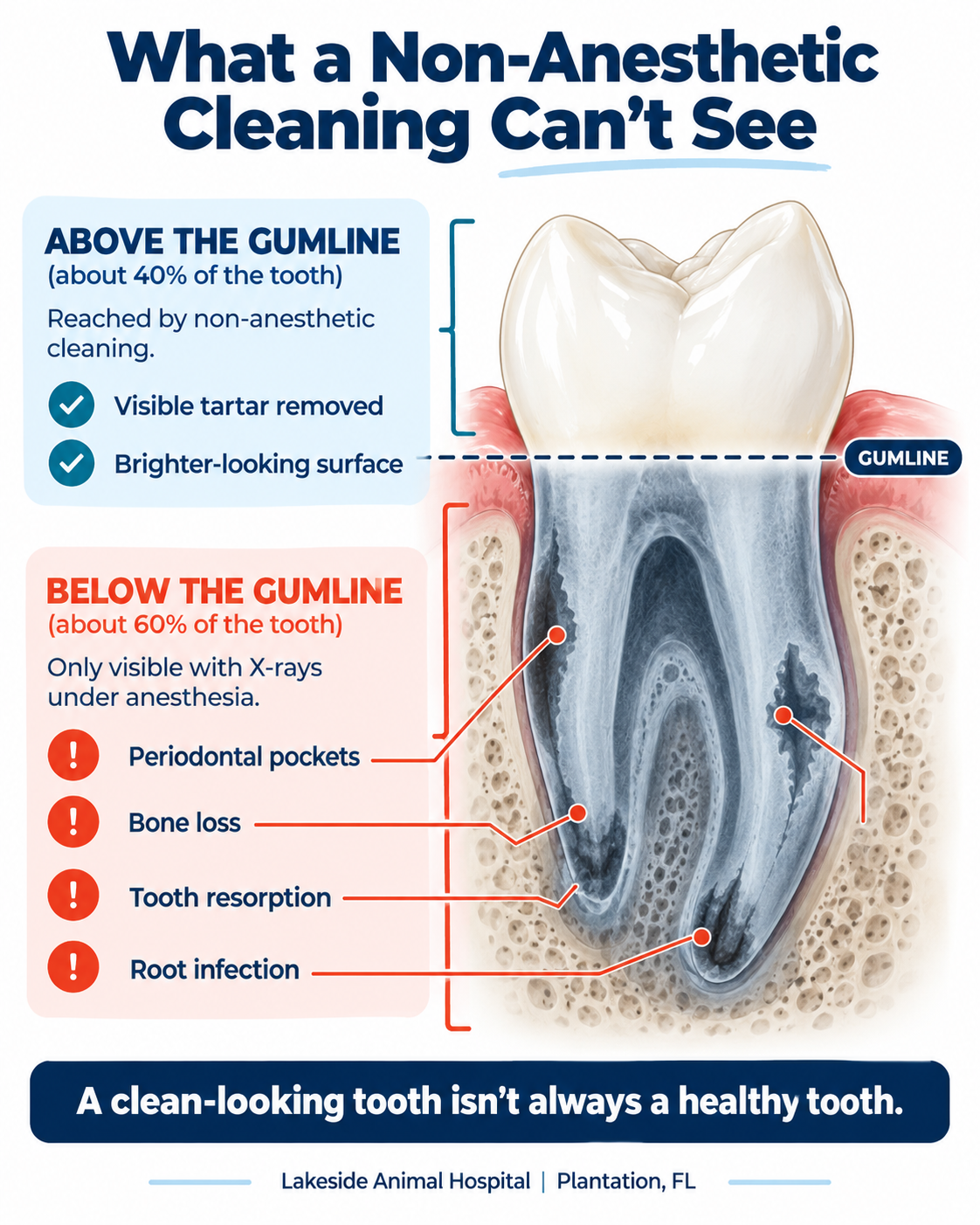
Non-anesthetic cleaning can scale away visible plaque and tartar from the crown, the part of the tooth you can see. That improves appearance and can freshen breath for a while, but it doesn't address disease happening beneath the gum tissue.
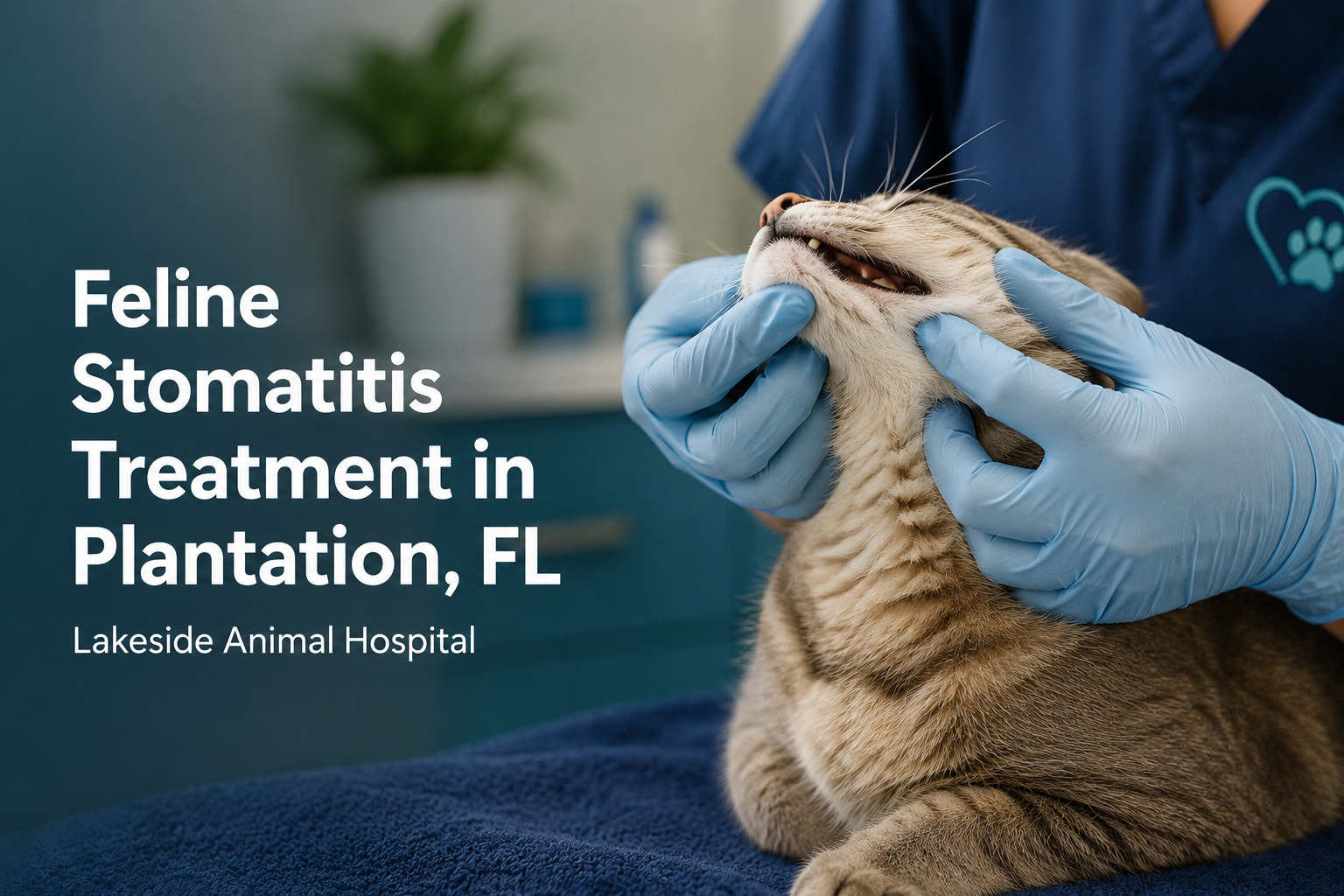
During a sedation-free cleaning, a technician gently restrains your pet and uses a hand scaler on the outer tooth surfaces. Most awake pets won't hold still for work on the inner surfaces facing the tongue. They also won't tolerate a probe slipping into the small space between the tooth and gum.
That space, called the periodontal pocket, is exactly where bacteria settle in and do their damage. So the result is a whiter tooth on the outside, with the root and pocket left unchecked. Those scaling limitations are the heart of the issue.
Why Does This Matter for Long-Term Dental Health?
Most dental disease, including the kind that eventually leads to extractions, starts and progresses below the gumline. An awake pet won't tolerate the probing or dental radiographs needed to find it.
Roughly 60 percent of each tooth sits below the gums. Periodontal disease (infection of the gum tissue and bone that hold a tooth in place) works quietly there, loosening teeth long before the surface looks bad. In cats, tooth resorption, where the body slowly breaks down the tooth structure itself, often begins at or under the gumline and can be quite painful.
Reliable periodontal disease detection depends on full-mouth X-rays and a tooth-by-tooth exam, and both require anesthesia. Caught early, treatment is simpler. Found late, extraction is often the kindest option, which is a big part of why dental X-rays matter before extraction. The root tells a story the crown can't.
As Dr. Jennifer Frione, DVM, puts it: "I've X-rayed plenty of mouths that looked fine on the surface and found real disease underneath, and that's what a scrape alone will always miss."
Is Non-Anesthetic Dental Cleaning Safe, or Does It Carry Hidden Risks?
For most pets, it carries real risks: stress from restraint, sharp instruments working near an awake animal, and a false sense of security about their oral health. The American Veterinary Dental College does not recommend anesthesia-free cleaning as a substitute for complete dental care.
Non-anesthetic dental risks go beyond the cleaning itself. Scaling without polishing leaves tiny scratches in the enamel that collect plaque faster. Without a breathing tube in place, loosened debris and bacteria can be inhaled.
The biggest risk is the quiet one. A mouth that looks clean can convince you everything is fine while infection spreads underneath. That's the real difference in the cosmetic vs medical dental cleaning debate.
Your pet is family, and we treat them as if they are ours. That's why a full dental visit at Lakeside includes pre-anesthetic bloodwork, careful monitoring from start to finish, and a personalized treatment plan built around your pet's age and health. You can see exactly what that looks like through our dental care services.
Quick Questions
Can non-anesthetic cleaning catch problems like resorptive lesions?
No. Resorptive lesions and other below-gumline disease show up on dental X-rays and during a careful probing exam, and both require anesthesia. An awake pet won't allow either. Many of these lesions are invisible from the outside, even when they're causing real pain.
Is non-anesthetic cleaning ever a reasonable option?
It may have a limited role for a pet who is a poor anesthesia candidate and only needs light surface tartar removed. Those cases are less common than most owners expect, and this approach shouldn't replace a full anesthetic dental exam for ongoing oral health.
Is anesthesia safe for older pets?
For most senior pets, yes, with the right precautions. Pre-anesthetic bloodwork screens kidney and liver function, the anesthetic plan is matched to the individual pet, and a trained team monitors heart rate, breathing, and blood pressure throughout. Age alone isn't a reason to skip dental care.
See What a Full Dental Exam Involves
So, is non-anesthetic dental cleaning safe? It can make teeth look better, but it can't tell you whether they're healthy. At Lakeside Animal Hospital, dental X-rays are included as standard practice with every anesthetic cleaning, so nothing below the gumline goes unseen. Learn what a full dental exam involves, then schedule your pet's visit with our team serving Plantation, Sunrise, and Lauderhill.