What Is Vet-Supervised Dog Grooming and Why Does It Matter for Your Pet's Safety?
TL;DR
- Vet-supervised dog grooming means your pet is groomed inside a fully licensed veterinary facility with a doctor on-site and available throughout the appointment.
- Unlike retail grooming chains, any medical issue found during the appointment like a skin condition, a stress response, a cardiac episode, can be addressed immediately by a veterinarian.
- For senior dogs, brachycephalic breeds, and medically complex pets, this distinction is clinical, not cosmetic.
Plantation families take their pets seriously. If you've ever dropped your dog off at a grooming salon and spent the next two hours wondering whether everything was okay, that instinct is worth paying attention to. Dog grooming in Plantation, FL looks the same from the outside whether you're walking into a retail chain or a full-service veterinary clinic. The experience inside is a different story entirely. This article explains what vet-supervised grooming actually means, which dogs benefit most from it, what the real risks of a standard salon are, and what your pet's grooming appointment looks like at Lakeside Animal Hospital.
What Does Vet-Supervised Grooming Actually Mean?
Vet-supervised grooming means your dog is groomed inside a veterinary clinic where a licensed doctor is present and available throughout the entire appointment. It is not a groomer who occasionally passes by an exam room. It means medical response capability exists in the same building, during the same appointment, from start to finish.
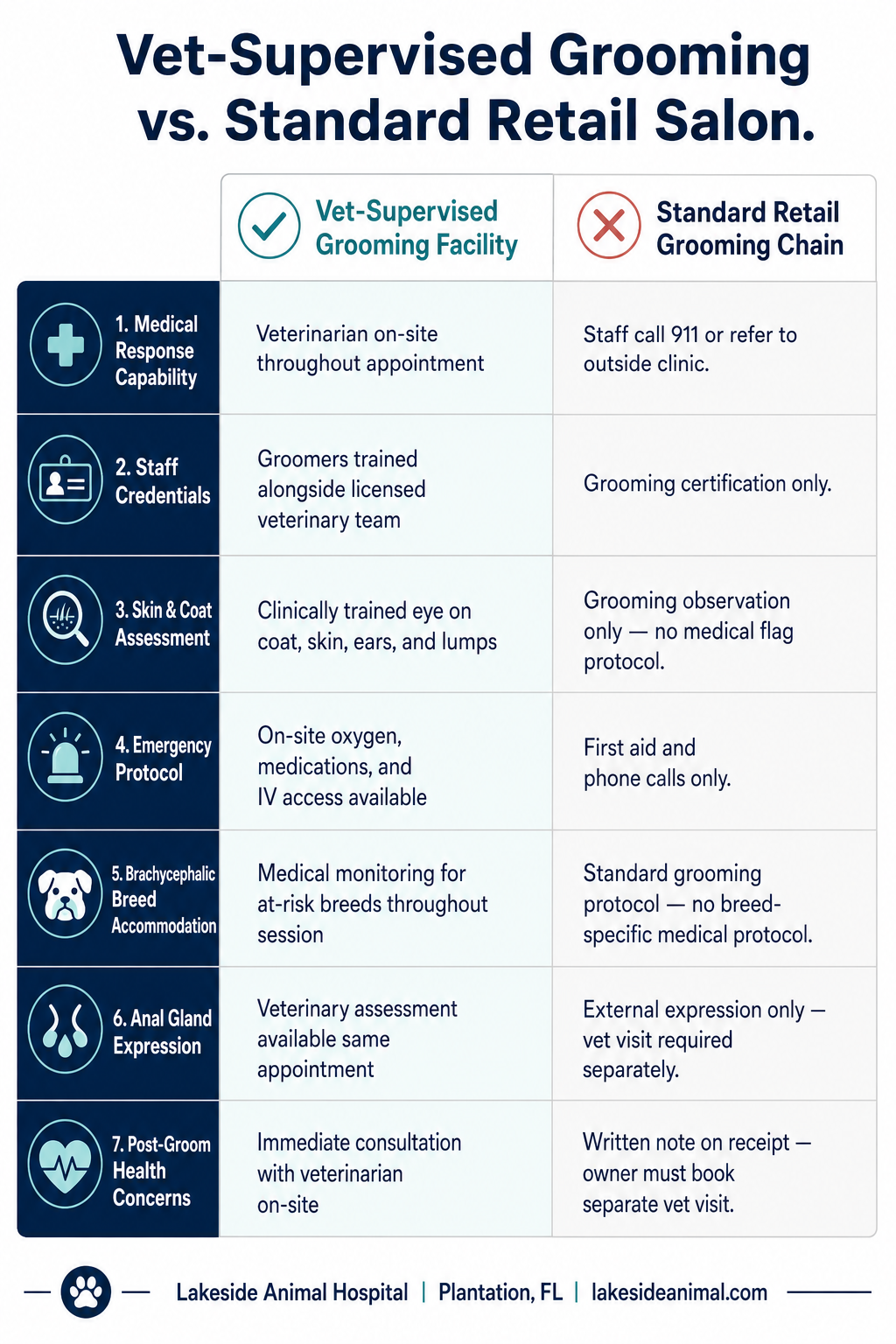
At a standard grooming chain, the grooming staff is trained in grooming. That's their specialty, and many are skilled at it. But if a dog shows signs of respiratory distress, has a seizure, or goes into cardiac stress mid-appointment, the options are limited to calling 911 or rushing the animal to a vet clinic across town. Time is the variable that matters in those moments.
Which dogs benefit most from veterinary-supervised grooming?
Senior dogs top the list. As dogs age, their cardiovascular systems become less reliable under stress, and grooming (particularly drying and restraint) is physiologically stressful even for calm animals. Brachycephalic breeds (bulldogs, French bulldogs, pugs, Boston terriers, shih tzus) face respiratory challenges under ordinary conditions that can be compounded by heat, stress, and positional restraint during grooming. Dogs with diagnosed heart conditions, diabetes, epilepsy, or undiagnosed conditions their owners don't yet know about also fall into this category. For any of these animals, having a DVM in the building is the difference between a grooming appointment and a medical event that becomes a crisis.
What Are the Real Risks of Grooming at a Retail Chain?
Grooming-related incidents at retail chains, including stress-induced cardiac events, seizures, hyperthermia, and respiratory distress in brachycephalic breeds, are more common than most Plantation pet owners realize. Without a veterinarian on-site, grooming staff have limited options when a dog's condition deteriorates, regardless of how well-intentioned or experienced they are.
The grooming environment itself introduces stress factors that don't exist at home: unfamiliar smells, sounds from other animals, restraint, the dryer, and the handling of sensitive areas like ears, paws, and the anal gland region. Most dogs tolerate this fine. But dogs with underlying health vulnerabilities often don't show symptoms at home because their home environment doesn't trigger the same physiological load.
Brachycephalic and flat-faced breeds carry specific risks at standard salons.
Bulldogs, pugs, and French bulldogs have anatomically narrowed airways. When they overheat or experience stress, their ability to self-regulate drops quickly. Groomers at retail chains are trained to identify some warning signs, but they are not trained to intervene medically. They don't have oxygen, they don't have IV access, and they can't administer medication. A veterinary facility can do all of those things within seconds of a dog's condition changing.
Stress responses during grooming are real and sometimes severe.
Elevated cortisol, panting, pacing, trembling, and whale-eye are early signals. Vomiting, loss of bladder control, and collapse are later ones. In a vet-supervised environment, the team is watching for these signals with clinical training behind their eyes, not just grooming experience.
What Services Are Included in Grooming at Lakeside Animal Hospital?
Grooming at Lakeside includes everything in a standard full-service appointment (bath, blow dry, breed-appropriate haircut, nail trim, ear cleaning, and brushing), plus a trained clinical eye on your pet's skin, coat condition, ears, and overall physical presentation throughout the visit.
That last part is worth spelling out. Groomers at Lakeside are working in a veterinary environment where skin abnormalities, unusual lumps, ear odor, coat thinning, and other early indicators of health issues are recognized as clinically relevant, not just cosmetic concerns. When something is flagged, the path to a veterinarian is immediate.
Groomers find things owners don't.
Owners see their dogs every day. That familiarity makes gradual changes easy to miss. A groomer handling your dog's entire body in a systematic, thorough way is often the first person to notice a new lump, a patch of hair loss, abnormal skin coloration, a tick that was missed at home, or an ear canal that smells wrong. At a retail salon, that observation typically ends with a note on your receipt. At Lakeside, it can turn into a same-day veterinary consult.
Anal gland expression, groomer or veterinarian?
A trained groomer can perform external anal gland expression as part of a grooming appointment. For most dogs, this is appropriate and sufficient. But if your dog has a history of impaction, infection, or recurring anal gland issues, veterinary expression and examination is the correct standard of care. At Lakeside, the proximity of the grooming and medical teams means this distinction is handled correctly every time, without requiring a second appointment at a separate facility.
How Much Does Dog Grooming at a Vet Office Cost Compared to a Salon?
Vet-supervised grooming is typically priced somewhat higher than a standard retail salon appointment. That difference reflects the clinical environment, professional veterinary oversight throughout the visit, and the medical response capability present during every appointment.
The honest framing is this: you are not paying more for a fancier shampoo. You are paying for the infrastructure behind the appointment. A licensed veterinarian on-site. A team trained to recognize medical distress. Equipment and medications available if your dog needs them. For pet owners in Plantation whose dogs fall into any medically vulnerable category, that cost difference is straightforward to justify.
For healthy, young dogs with no underlying conditions, the calculus is more personal. Many owners who have experienced a grooming incident at a retail chain, or who simply want to consolidate their pet's care under one roof, find the choice easy. Others see it as the right preventive standard regardless of their dog's current health status.
How Does the Grooming Appointment Process Work at Lakeside?
The appointment process at Lakeside is designed around your dog's comfort and your peace of mind. When you arrive, your dog is checked in by a team that knows the difference between a dog who's a little nervous and a dog who's showing signs of clinical anxiety and knows what to do about it.
Grooming is performed in a clean, calm environment inside the veterinary facility. The medical team is available throughout. When the appointment is complete, your dog is returned to you clean, calm, and assessed by people with clinical training, not just grooming credentials. [LINK TO: /grooming]vet-supervised dog grooming at Lakeside in Plantation[/LINK] is available for dogs and cats, and new patients are welcome.
For dogs with specific coat types, breed-related grooming needs, or anxiety histories, it's worth mentioning those details when you book. The team can prepare accordingly.
Lakeside serves Plantation, Sunrise, Lauderhill, and Plantation Gardens. If your dog's last grooming experience left you uneasy or if you've simply been looking for a way to bring grooming and veterinary care under one roof, this is the straightforward solution.
Frequently Asked Questions About Vet-Supervised Dog Grooming
Is grooming at a vet office more expensive than a regular salon?
Vet-supervised grooming is typically priced somewhat higher than a standard retail salon appointment. The difference reflects the clinical environment, veterinary oversight throughout the appointment, and the ability to identify and address medical issues, like skin conditions or ear infections, discovered during grooming. For many Plantation pet owners, that added layer of safety is the deciding factor.
Can a groomer express a dog's anal glands, or should a vet do it?
A trained groomer can perform external anal gland expression as part of a standard appointment. If your dog has a history of impaction, infection, or recurring anal gland problems, veterinary expression and examination is the appropriate standard of care. At Lakeside, the proximity of our grooming and medical teams means this is handled correctly every time, without a second trip to a separate facility.
What should I do if my dog had a bad experience at a grooming chain?
Start with a veterinary evaluation to rule out underlying conditions that may have been triggered or worsened during the appointment. A seizure, respiratory episode, extreme anxiety response, or physical injury all warrant clinical assessment before any future grooming appointment. Choosing a vet-supervised facility significantly reduces the risk of a repeat event, especially for medically vulnerable dogs. What to do after a grooming incident at a chain salon.
How often should I have my dog professionally groomed?
Most dogs benefit from professional grooming every four to eight weeks, depending on breed, coat type, and activity level. Dogs with continuously growing coats like poodles, doodles, shih tzus, and bichons, typically need more frequent appointments to prevent matting and the skin issues that develop underneath an overgrown coat.
Dr. Frione's Perspective on Grooming Safety
"I've seen grooming-related incidents walk through our door more times than I'd like. What strikes me every time is that the owners had no idea their dog was at risk, they thought they were dropping off for a bath and a trim. In my experience, brachycephalic dogs, senior dogs, and dogs with undiagnosed cardiac conditions are the most vulnerable in a standard salon environment. Having a veterinarian in the building isn't a luxury for those animals, it's a genuine safety net. I recommend our grooming services specifically because I know what's in place if something goes wrong."
— Dr. Jennifer Frione, DVM, Lakeside Animal Hospital
Ready to Book a Grooming Appointment Your Dog Will Actually Be Safe For?
Every grooming appointment at Lakeside is backed by a full veterinary team and not just a groomer with a phone number for emergencies. If your dog is a senior, a brachycephalic breed, or has any history of health complications, that distinction matters more than most pet owners know before something goes wrong.
Dr. Frione and the Lakeside medical team have served Plantation families for over 10 years from our full-service veterinary facility. We welcome new patients from Plantation, Sunrise, Lauderhill, and Plantation Gardens. All breeds and sizes are welcome. Our grooming team works inside the same facility where your dog could receive veterinary care within minutes if anything changed.
You can explore our vet-supervised dog grooming at Lakeside in Plantation services or call us directly to book. You can also learn more about skin conditions we identify during grooming appointments and how early detection protects your pet's long-term health.
Your pet is family. We treat them like they're ours.