My Dog Had a Seizure at a Grooming Chain: What Should I Do and How Do I Find a Safer Groomer?
TL;DR: If your dog had a seizure or health episode during grooming, get a veterinary evaluation before booking another appointment anywhere. For dogs with a known or suspected seizure history, vet-supervised grooming is the appropriate standard of care going forward.
It's terrifying. Your dog went in for a routine groom and came out with a health scare. If this happened to your pet, you are not alone, and the questions you're asking right now are exactly the right ones. Pet owners across Plantation, Lauderhill, and Broward County have faced this same situation, and the path forward starts with one clear step: a veterinary evaluation before anything else.
What Should You Do Immediately After a Grooming-Related Health Incident?
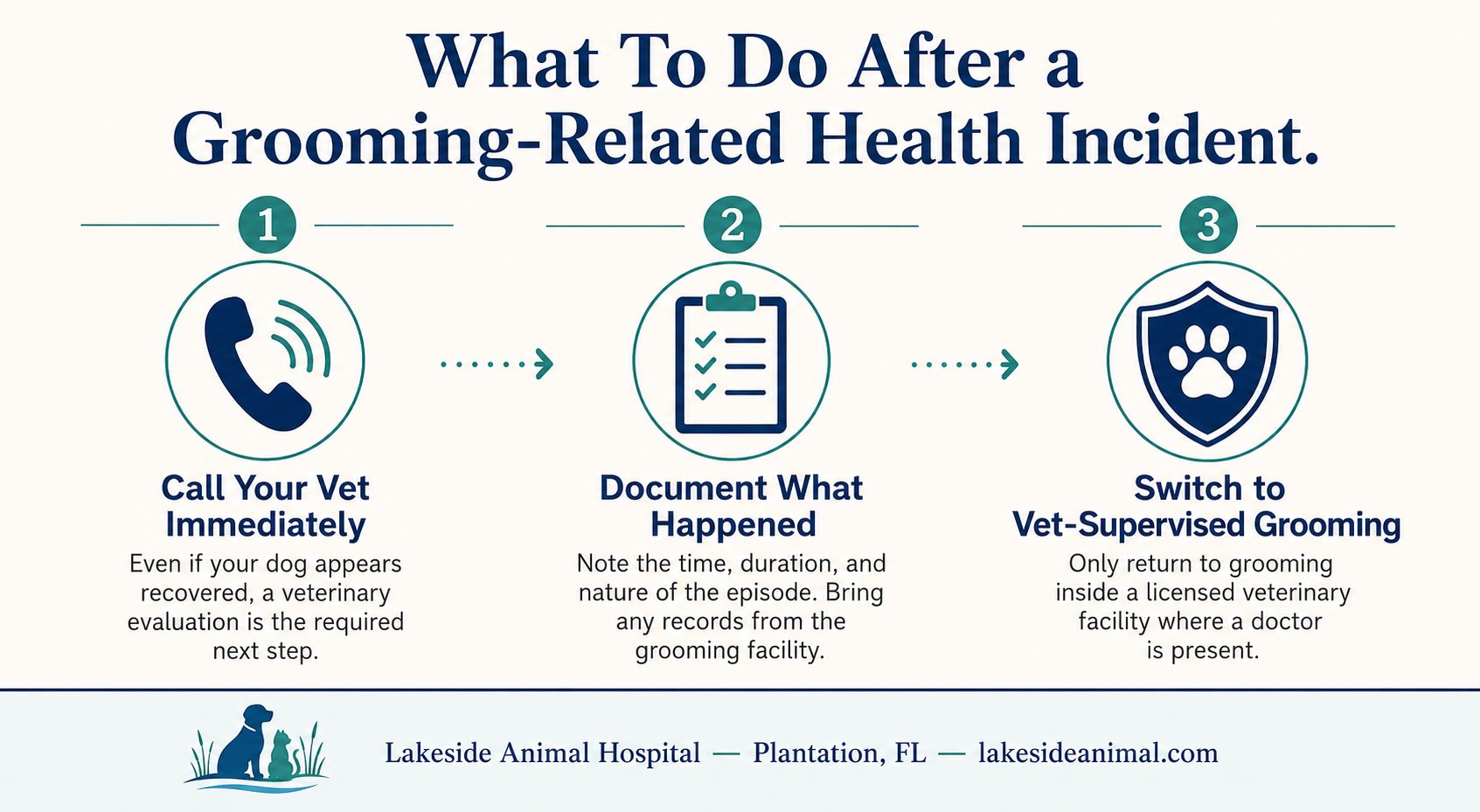
If your dog had a seizure, collapsed, or struggled to breathe during a grooming session, schedule a veterinary evaluation as soon as possible, even if your dog appears to have fully recovered by the time you picked them up.
Grooming-related stress can trigger or reveal underlying conditions that have nothing to do with the groomer's technique. Cardiac arrhythmias, respiratory compromise, primary seizure disorders, and syncopal (fainting) episodes triggered by vagal responses to restraint can all present during a grooming appointment. Without a diagnosis, you have no way to know which of these your dog experienced, and that matters enormously for what happens next.
Bring any documentation the grooming facility gave you. Note the approximate time the episode occurred, how long it lasted, and what your dog was doing immediately before it happened. That detail helps your veterinarian work through the differential and identify what actually occurred.
Book a post-incident veterinary evaluation at Lakeside Animal Hospital so your dog gets a full workup before another grooming appointment is considered.
Why Do Some Dogs Have Health Episodes During Grooming?
Grooming is physically and emotionally demanding for certain dogs, and the conditions at many retail grooming chains create a real risk for vulnerable animals.
Dogs with brachycephalic anatomy (bulldogs, pugs, French bulldogs, shih tzus) are at elevated risk because their upper airway anatomy makes sustained exertion and heat exposure genuinely dangerous. Dogs with undiagnosed cardiac conditions may experience arrhythmias under restraint. Dogs with anxiety or a history of trauma can escalate to a full stress response when confined in an unfamiliar, high-noise environment.
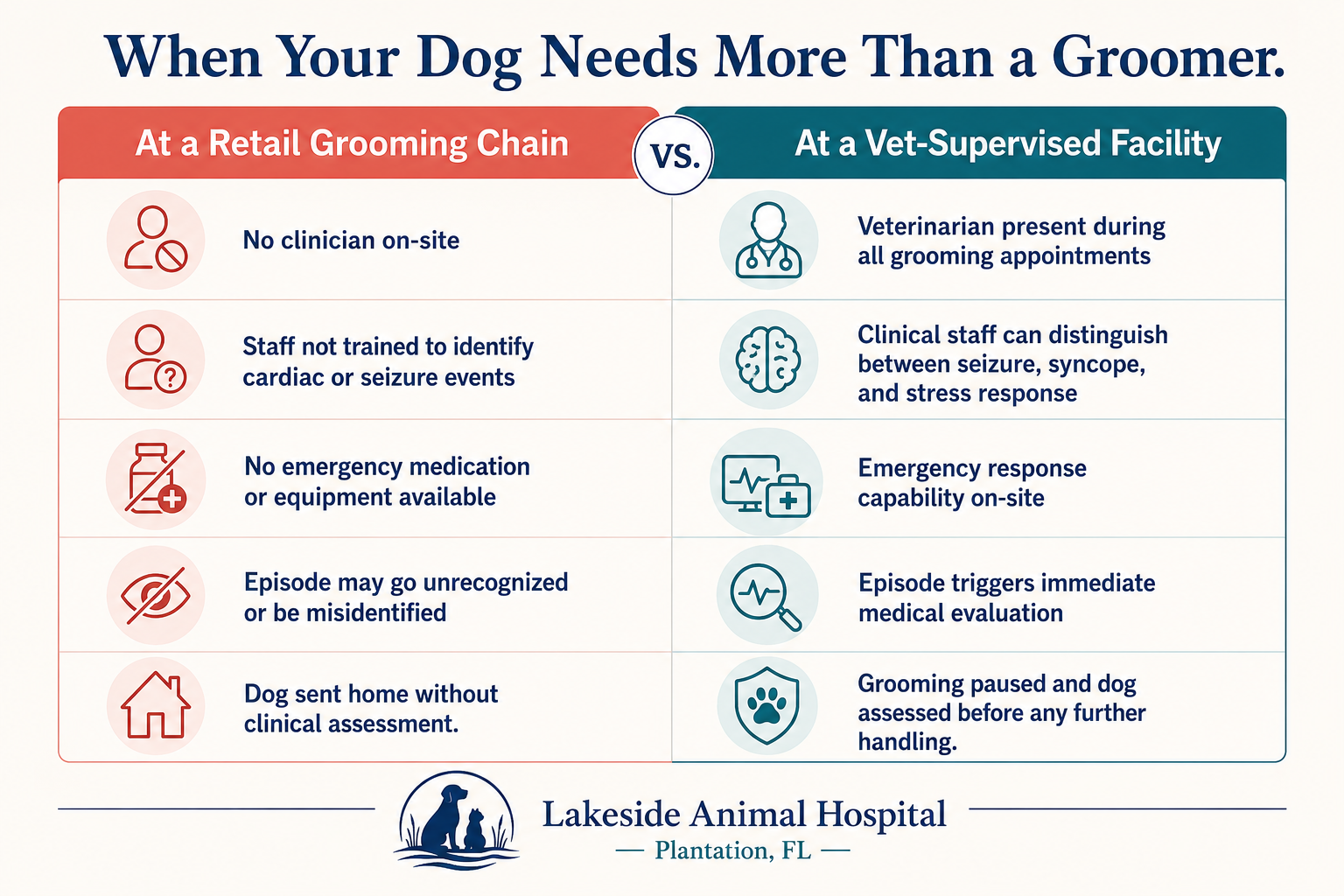
At a retail grooming chain, there is no one present who is medically equipped to recognize the difference between a stress response and a cardiac event, or between a seizure disorder and a syncopal episode. The average groomer is trained in coat care, not clinical triage. That gap is exactly what makes the vet-supervised model different.
How Do You Find a Vet-Supervised Grooming Facility Near Plantation, FL?
A true vet-supervised grooming facility operates inside a licensed veterinary clinic where a doctor is physically present during grooming appointments. That is not the same as a grooming salon that says it works alongside a nearby clinic.
Lakeside Animal Hospital in Plantation offers full-service grooming within its veterinary facility. Groomers work with a veterinary team on-site, which means that if your dog shows any sign of distress during the appointment, clinical response is immediate. For dogs coming in after a grooming-related health incident, that on-site medical capability is not a perk. It is the reason to be there.
Lakeside serves pet owners in Plantation, Lauderhill, Sunrise, and surrounding Broward County communities. To understand
what vet-supervised grooming means for medically complex dogs in Plantation, the full guide walks through how these appointments are structured and what to ask before you book anywhere.
Quick Questions
Can grooming stress cause seizures in dogs?
Yes. In dogs with underlying seizure disorders, the stress of grooming can act as a trigger. Some episodes that appear seizure-like are actually syncopal events caused by cardiac arrhythmias or vagal responses to restraint. A veterinary evaluation after any grooming-related episode is the only way to distinguish between these and determine the safest path forward for your specific dog.
Is it safe to groom my dog again after a seizure incident?
Not until a veterinarian clears them. Depending on the diagnosis, your vet may recommend medication, modified grooming protocols, or grooming only in a supervised veterinary setting. Returning to the same type of environment without a workup puts your dog at risk of another episode.
What should I tell the vet when I bring my dog in after a grooming incident?
Bring any written documentation from the grooming facility. Note the time, duration, and nature of the episode. Describe your dog's behavior in the days leading up to it, any medications your dog takes, and whether anything like this has happened before. The more specific your account, the faster your veterinarian can narrow down what occurred.
"A dog who has had a health episode during grooming should never go back to an unsupervised grooming environment. That is not a preference. That is a medical recommendation."
— Dr. Jennifer Frione, DVM, Lakeside Animal Hospital
Ready to Take the Next Step for Your Dog?
After a grooming-related health incident, the next two steps are straightforward: a veterinary evaluation first, then supervised grooming going forward.
Lakeside Animal Hospital's veterinary team is on-site every day, and our grooming facility operates inside the clinic. Plantation families trust us with their pets because we treat every animal as if they were part of our own. Whether your dog needs a post-incident workup or you are looking to transition to a safer grooming environment, we are here.